Managed by Nodes.
A Nodes-managed boundary, separate from your cloud, under agreed data and operating terms.
Your people spent years learning what works in your business. Nodes Engine connects that judgment with your company records and the reasons behind earlier decisions. Ask it a question, or have it check agreed sources for a change, such as a partner notice that puts your application form out of date. It investigates, compares options and carries out approved work. Nodes Connector connects your systems and verifies each integration. Nodes AI FDE, our AI forward-deployed engineer product, configures and tests each workflow.
No company data needed for the first conversation. See how the first decision brief works ↓
Nodes has been live since 2023. Our public production reference is one Fortune 500 insurance carrier, live since January 2025 across 200+ locations nationwide, where Nodes supports insurance-agent hiring, licensing progress and educational support. In hiring, Nodes evaluated 900,000+ people and the carrier hired 10,000+ insurance agents from that pool. Those figures describe hiring; other workflows need their own validation. Nodes is SOC 2 Type II attested.
Illustrative example: a partner requirement reveals a missing field. The partner will require site-access details on every application, and your current form does not ask for them.
At the agreed checking frequency, Nodes finds the partner notice, its effective date and the open applications it affects.
Nodes pulls earlier decisions on similar notices. The owner explains local exceptions: only restricted-access sites need opening hours.
Nodes weighs four options: a guide update, a submission check, more evidence or waiting. The owner can inspect each option’s evidence, estimates and assumptions.
Nodes carries out approved work, such as the form update, within current permissions and delegated authority. Required approvals go to the owner first.
Nodes compares returned applications, completion time, rework and operating costs with the baseline.
The Decision Trace keeps the notice, the owner’s exception, the choice and the result. Nodes checks current conditions before reuse.
Nodes Engine uses the tools and agents a job needs. For a form change like this, one tool can be enough.
The first decision brief is paid analysis of one question, such as which renewal risks warrant action. Within 72 hours of complete agreed data access, it identifies at least $1M in potential business value over an agreed measurement period, with findings, options and action/inaction cost estimates.
Confirm sources, local context, permissions and baseline gaps.
After complete agreed data access: findings, gaps, options, cost estimates and next steps.
Agree delivery and later measurement if you proceed.
The owner sets their decision timetable. Decision brief, fee and terms →
The 72-hour window covers analysis and recommendations after complete agreed data access. Implementation is separately scoped and scheduled.
| Step | Consulting firms | Nodes |
|---|---|---|
| Get started | Scope staffing and access. Time required: Staffing and access vary. |
Agree owners, baseline and access. Time required: Typically 1-2 weeks. |
| Understand the problem | Investigate evidence and causes. Time required: Within BCG’s broader 4-6 week diagnostic/design reference.* |
Investigate evidence and context. Time required: Within 72 hours of complete agreed data access. |
| Choose a solution | Present options for decision. Time required: Agreed diagnostic and decision schedule. |
Review findings, options and costs. Time required: Recommendations within 72 hours; customer decides afterward. |
| Implement the change | Agree delivery scope and resources. Time required: Set by implementation scope. |
Implement with required approvals. Time required: Separately scoped and scheduled. |
| Measure and improve | Review results and lessons. Time required: Agreed observation period. |
Measure results, costs and effort. Time required: Later agreed observation period; ongoing record. |
*BCG’s 4-6 weeks describe a broader corporate-functions diagnostic and design engagement, not an equivalent benchmark for one Nodes question. Schedules vary. See the published approach.
Nodes Engine creates the context graph, your company’s knowledge graph connecting records, relationships, human judgment, decisions and outcomes. In the partner example, the graph links the notice, the form, the local guide, the owner’s exception and the result. Your company already paid for this knowledge, decision by decision. Nodes exists so you can act on it without giving it up.
Ownership and retention → · Explore Nodes Engine →Nodes connects authorized records, documents and conversations from your separate systems with your people’s judgment and relevant outside developments. Your company keeps the graph, history and business rules.
Nodes investigates a question or a gap, such as a form that misses a new partner requirement, and compares options, including the estimated cost of acting or waiting.
Nodes builds and runs workflows in your existing systems under current permissions, carrying out steps such as a form update or a follow-up task. It records each decision and measures the result. Swappable models and agents work with all three Engine layers.
Your team decides what each person and agent can see and change. Read access, recommendations and permitted changes are set separately.
Required approval precedes execution for the changes your policy names, such as a customer message, a price change or a production workflow change. Routine work, such as an agreed reminder, stays within current authority. You can open the Decision Trace, pause the work or remove access.
Set task-quality and evidence requirements, exception limits and total AI and retained human cost. The owner decides whether to expand, hold or narrow delegated work.
Compare acting, waiting, more evidence and no change over one agreed period. Include implementation/integration, AI/infrastructure, human review, correction/rework, adoption, governance, monitoring and expected risks.
How Nodes Connector builds and verifies integrationsUse supported inputs and labeled assumptions. Keep time freed, cash saved, revenue and margin distinct. Show uncertainty and missing evidence.
How Nodes AI FDE configures and tests workflowsConfirming the implementation and measuring the business result are separate checks: the form can be updated while returned applications stay high. A better number afterward does not by itself prove the change caused it.
Decision Traces retain failed and inconclusive outcomes. Nodes checks current internal and external conditions before reusing a lesson.
This sample trace shows a sales follow-up moving from evidence and approval to a task Nodes wrote and verified. Its business result still awaits measurement. People with access can question a recommendation or add a correction.
Source dates, contrary evidence, assumptions, approvals and later outcomes. The owner reviews quality, exceptions and total costs before changing delegation.
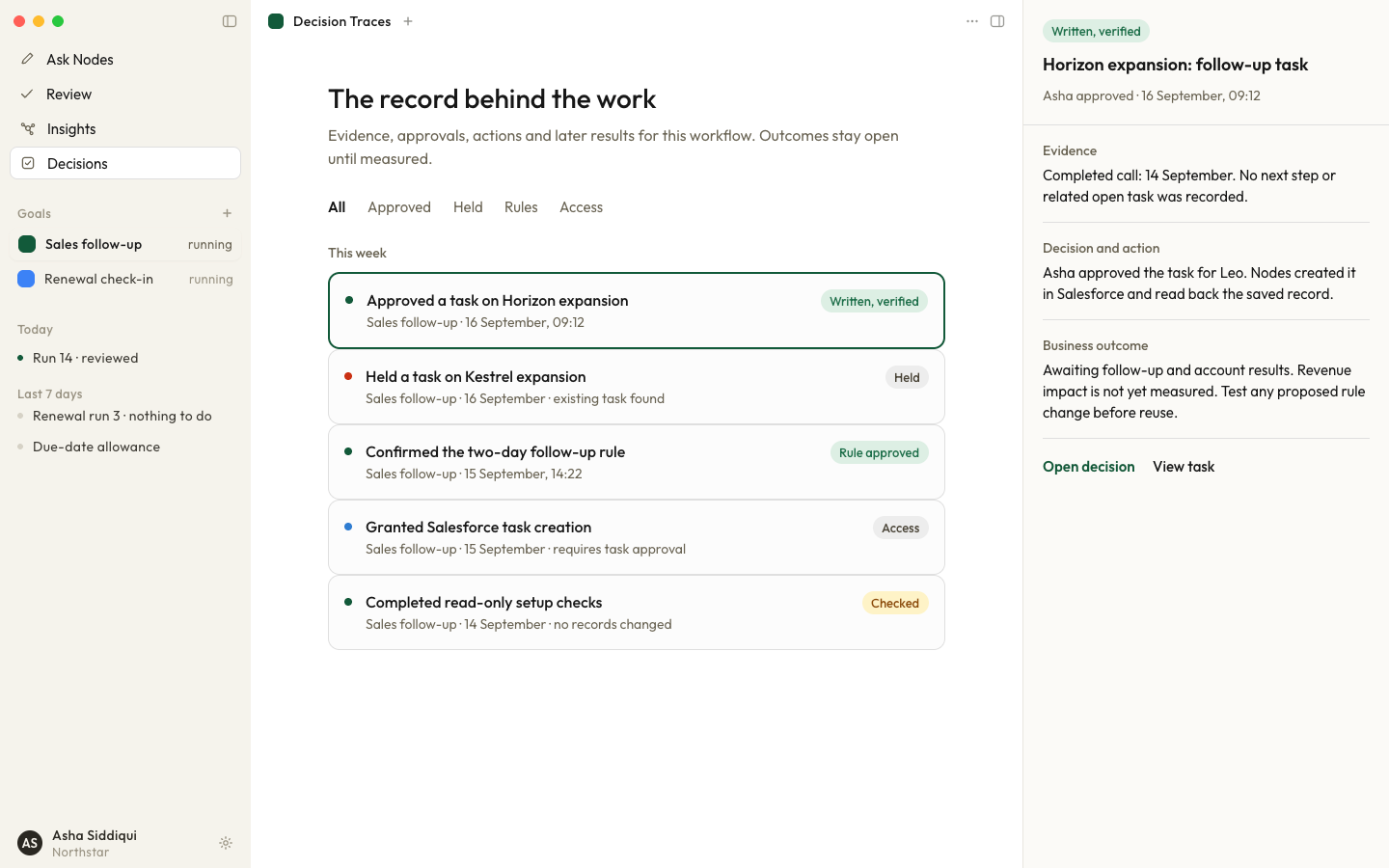
Your team works in the Nodes desktop app. Agree where Nodes runs and where data flows before it gets access.
A Nodes-managed boundary, separate from your cloud, under agreed data and operating terms.
Single-tenant deployment in your approved cloud boundary.
Customer-managed: your team runs the infrastructure.
Use the models and agents that fit the task. Evaluate each replacement against task quality, latency, risk and total AI and human cost.
Private VPC and on-premises configurations can enforce zero customer production-data egress within the approved boundary. Retention, transition and continued runtime follow the agreement. Compare VPC and on-premises licensing with a Nodes Cloud subscription.
Yes, if company records, rules, Decision Traces, outcomes and tests remain outside one model. That history stays available to a replacement, but its answers and actions still need tests for quality, access, latency and cost. Retained history does not guarantee identical behavior.
Review ownership and exportYes, when external sources are permitted, dated and relevant. A partner notice, for example, becomes useful once Nodes checks which open applications, forms and sites it affects. Keep the source, date, usage rights and any unresolved mismatch visible.
Review source boundariesBring its owner too. We show how Nodes would approach it, which records it would need and who would approve the work. No company data needed for the first conversation.